Today’s author interview is with Business Strategist Jamie Palmer, who truly changed my life when she introduced me to Human Design. Some of the lights that went on:
 I stopped wondering why many past business coach’s strategies hadn’t worked well for me. I finally understood why I needed different strategies, and Jamie helped me discover what those strategies were!
- I learned how to make decisions in a way that worked for my specific human design, which meant waiting, riding “the roller coaster of emotion,” and then deciding which landed better results and fewer jump-in-the-water moments where I’d then need to backtrack from having said “yes” too soon, based only on initial enthusiasm.
- I honored my design, which included taking time off to refuel.
- My circuitous career path—the various jobs, skills, decisions, and experiences—suddenly made sense in a fulfilling and joyful way. I could stop judging myself about it.
- I was able to work smarter, not harder.
- My level of fulfillment and enjoyment increased.
- My health improved.
- My relationships improved.
- As you can see in this guest post I wrote for Jamie Palmer’s Human Design blog, I found ways of writing, publishing and marketing Breathe. Write. Breathe. that were consistent and synergistic with my human design as a projector, leading to a more effective and joyful experience.
Jamie is the author of Human Design for Business, a book that could similarly impact your life as a writer and author, your work, and more. I’m thrilled to introduce you to Jamie and have her share insights into the writing and publishing process and the business around your book based on your Human Design.
What Is Human Design?
Lisa: What is Human Design?
Jamie: Human Design is like if DISC (personality profiles), StrengthsFinder and Enneagram had a baby — that’s human design.
Lisa: What led you to study Human Design?
Jamie: I couldn’t unsee what human design showed me about myself. As a logical person, it was hard to forget all the knowledge the human design system had reflected to me simply by entering my birthdate, time and place. I started studying for myself, then came my family and friends, and I realized I could use it for business.
Workshop Leads to Writing Human Design for Business Book
Lisa: What i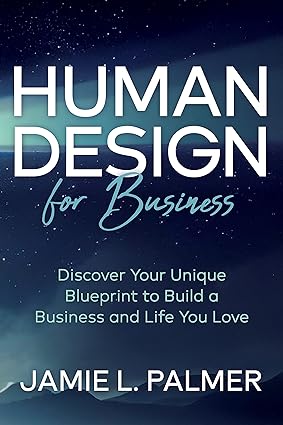 nspired you to write Human Design for Business?
Jamie: After creating my Business Design with Human Design Workshop, I had an intuitive nudge to write the book. I had so many clients who went through the workshop asking for more. I knew I had always wanted to write a book. In fact, I had written two books on business that were sitting on my computer, and I knew this might be the right book for me to release. After researching and realizing that no one had written anything on Human Design for business, I decided to proceed.
12 Weeks to Create a Course and a Plan
Lisa: What was your book writing process?
Jamie: This is an interesting question because it is a non-traditional way to write a book. I wrote the book alongside creating the Human Design For Business (now known as HD Your Biz) Course. Essentially, I just wanted to get some proof of concept while writing. I aimed to enroll ten people, and I ended up with 67.
Each day for the 12-week program, I would get up at 4 am to write for 3 hours before starting my day. In 12 weeks I had 85,000 words down on paper, a course and a plan. I spent the next six months editing the content based on the feedback from the course. It wasn’t typical, but I am now leveraging this process for other books I plan to release. For me, the writing process supports creating my programs as well. It forces me to think differently than if I were just to teach.
Simplifying Complicated Material
Lisa: That’s an excellent and efficient way to write a book—and, as you mention, a great way to get proof of concept and feedback. Human Design is fairly complicated, yet Human Design for Business is accessible. Can you share how your book structure and content help break it down and make the information accessible to someone new to human design?
Jamie: I divided the book into Human Design and Human Design for Business. When they come into my world, I find that most people don’t know much about their design. In presenting it this way, I thought it would provide a foundation to leverage their business design more efficiently rather than just telling people. I firmly believe that the parts don’t exist without the whole in human design. I don’t know what your experience is as a human, so breaking it down into parts, I believe, allows people to take what resonates with them and leave the rest.
Lisa: Part I teaches the foundational aspects of human design, and Part II of the book offers different models for someone’s human design type. In Part II, you also address how, depending on your type/design, the most effective and fulfilling way to handle sales and marketing is in alignment with one’s human design. You also address the most empowering perspective, depending on the type, and finally, address productivity according to type. Can you share why you organized the book the way you did?
Business Book as Introduction to Deeper Work
Jamie: I look at the Human Design for Business book as an overview or a taste of human design and business. It gives you an introduction to this work and a foundation to begin the journey of HD’ing your business. The topics I included are the most common I have experienced with clients over the past 21 years in business. If we can align some of those with our design first, it will become easier to address the other aspects of business.
Lisa: What do you hope readers will get from reading Human Design for Business?
Building a Business at the Intersection of Design, Desires, and Lifestyle
Jamie: I hope that readers will be able to have a better understanding of themselves and validation around their experience. I hope they stop trying to shrink themselves and instead build a business at the intersection of their design, desires, and lifestyle. We must create a business around our human design instead of trying to fit ourselves into businesses that don’t suit us.
Lisa: Working with you as a business strategist helped me in the ways you mentioned. How does an entrepreneur’s or writer’s human design play a role in their business or writing work?
Jamie: I believe it plays a massive role. Too many entrepreneurs take the risk of going into business for themselves. Yet, they outsource their decision-making to gurus and experts who have a homogenized and formulaic approach to how they “should” structure their business model or how they “should’ market their business.
Lisa: Yes, yes, yes!
Jamie: Ultimately, they want to burn the entire business to the ground because it isn’t aligned with who they are. For example, pressure launches — where the course or program opens up for a certain period, then enrollment closes. There are so many entrepreneurs I have worked with who are constantly sharing that they don’t feel comfortable pressuring their clients like that, and I agree.
Designed for Entrepreneurs and Writers
Too many entrepreneurs and writers have given their power away regarding their business (or writing practice). They outsource their decision-making and fail to honor what they genuinely desire to do. They follow the gurus’ formulaic advice and then feel deflated when it doesn’t work for them. It won’t because it is not designed for entrepreneurs and writers.
This is where Human Design comes in. This is why I believe human design education is so important, as well as educating clients on the many options available in business instead of pushing a formula. Clients who are aware of their human design and the many different options of business models can choose what works best for them based on their design and lifestyle.
Discovering the “not-self”
Lisa: Can you share the “not-self” and why it is essential to understand that aspect of our design?
Jamie: In human design, everything exists in dichotomy. For every high, a low. For every strength, a weakness. The not-self through the lens of human design is the low expression of our human design. It is the places in our human design where we do not honor the whole of ourselves or, because of society, culture, and family norms, are living out something that is not ours.
Lisa: What are some common issues related to the “not-self” in people’s businesses?
Jamie: The biggest one I see is should’ing. I should do this because…insert whatever place the entrepreneur gives away their power. Examples include:
- I should do this because it is typical in my industry.
- I should do this because so and so did it that way, and they are successful.
- I should post on social media every day because that creates consistency.
- I should do a launch because that is how all other people in my world do it.
- I should create yet another program, course or book.
This is where entrepreneurs give their power away because they buy into the belief that there is only one way to be successful. Whenever a client comes to me with a case of the should’s, I always ask, “Says who?” The reality is that there are many ways to be successful, and it is up to each individual to choose the correct way for them.
What to Expect When Writers and Business Owners Embrace Human Design
Lisa: What results have you seen when writers and business owners embrace their human design?
Jamie: Witnessing people do this work has been quite wild. I feel very fortunate to be able to hold space for people who step on this journey because it requires a bit of work, and I want to name that for those who are considering it. The results for those who step in and commit are wild, myself included. I’ve watched people go from a business they hate working 60 to 20 hours a week and making over 6 figures. I’ve watched other clients ready to go back to corporate do it on their own terms and create lifestyle businesses where they are traveling the world.
This work comes down to getting clear on what you design, owning your design and committing to building a business around that.
Lisa: What has been the response to Human Design for Business?
Jamie: The response has been overwhelming. Last count, there are books in over 35 different countries and nearly 10,000 copies sold. It has transformed my life and my business. Hands down, writing this book was one of the best decisions of my life. I regularly get people who come into my world after buying the book and sign up for one of my programs. It has been a game-changer.
Marketing Human Design for Business

Lisa: What have you done to get the book in the hands of readers, and what’s worked most effectively?
Jamie: I have used primarily organic SEO strategies on my blog and, secondarily, Amazon Ads. They have both worked well and require tweaking and honing. I started the blog in 2021 and have grown it to over 17,000 unique views each month, with an average time on the website of around two minutes and 15 seconds, which is high.
Amazon ads help me reach people actively searching for human design information within the Amazon ecosystem. Yes, it does cost money to go this route, but because I have an ecosystem off the back of the book: HD Your Biz, HD Wild, and Ideal Client Workshop, the cost to run the ads is offset by people opting into those programs. Approximately for every 25 books I sell, I enroll one new client into the $1888 HD Your Biz Program.
Using Human Design to Support Your Book Writing
Lisa: What has been your journey as a writer using human design to support your book writing and other writing?
Jamie: I think my human design supported me in accepting that I am a writer. I have gate 12 – the gate of the wordsmith, and knowing that permitted me to pursue it, I had spent most of my life being told, “It is hard to be successful as a writer; for me, as a 3/5 projector in human design, embracing writing brought me more than when I didn’t write. I have continued to double down on this. Ultimately, I plan to write more books to bring new people into my business ecosystem.
How Understanding Human Design Can Help with Your Writing and Publishing
Lisa: How can understanding one’s human design help a person with their writing and publishing?
Jamie: I think it better helps you understand how you will operate through the lens of writing, what values are important to you in publishing and pitfalls along the way. For example, I can look at the centers in human design to discern what content creation/writing blocks may come up for clients. I can look at profiles, gates and variables to see the emerging themes for clients and the best environment for them to write in.
For example, I have gate 9, the gate of focus, and gate 15, the gate of extremes. I tend to want to work in big chunks of time on one project. This might look like three months of writing for 3 hours each day, followed by three months of little to no writing. Meanwhile, someone with gate 5 might want to write daily, no matter what.
There are several different aspects in the chart I can look to to understand better habits, productivity, styles and perspectives that someone might have. All of this gives insights into writing and publishing.
Conditioning
Lisa: What is conditioning, and how does it happen? How does human design help us decondition?
Jamie: Conditioning is the societal, cultural, and family norms we are born into. Conditioning isn’t inherently good or bad. It is whether we identify with it and make it part of who we are or let it go. We don’t escape life without conditioning. The key is to not take it on as your own.
For example, you are reading this article: I am a 3/5 Projector with emotional authority, and Lisa is a 4/6 projector with emotional authority. We each bring a particular lens with which we see the world that conditions. This is why I am constantly saying take what resonates and leave the rest.
The challenge with conditioning usually stems from childhood, when conditioning is so deeply ingrained in us that we may struggle to separate ourselves. To decondition, we must first become aware of the story we are telling ourselves and recognize that there is a flag on the field of our lives. At first, it may take us weeks or even months to recognize that flag, but over time, we begin to notice it quicker and quicker until it isn’t even there anymore.
I also find somatics and ecotherapy practices helpful in letting go of deconditioning faster. Deconditioning often requires us to deconstruct and question our beliefs. This can and usually does radically change the way we look at the world or the people around us. Again, we do not escape life without conditioning. The books we read, the shows we watch, and the people we are around all condition us. The key is to let it go and not take it on as our baggage but to take what resonates and put down the rest.
 How to Integrate Human Design into Your Work as a Writer

Lisa: One aspect of human design works with gates and channels. Without us going into too much detail, can you share how this information might help someone with self-expression? For example, I have what are referred to as gates 56 and 31, but no channels. What does that tell you about me as a writer, and how can I integrate that into my work as a writer to be aligned, inspired and productive?
Jamie: Two things to understand that many people don’t talk about in human design. 1) All of the energy in the chart wants to come out of the throat to express who we are and how we take action in the world. 2) There is a specific way the energy flows in the chart. It can’t go any which way we want it — there is a highway for which it comes out of the chart and is expressed in the world.
I have pulled the information on the gates from my Human Design Gate Strengths Book.
Gate 32 – I support you with my ability to see the value of things and discern what next step/investment will support long-term success. I answer the question, “What foundation do I need to have in place to achieve ______ ?”
Gate 56 – I support you by sharing my stories to prove a point or illustrate a concept. I answer, “What story do I need to hear to see more possibility, growth or evolution?”
This tells me that as a writer who supports people in their writing, you will likely be conveying the foundations of what it means to write good stories that spark and create evolution. You likely do so through story and are looking ahead to the future to develop longer-term success for the writers who read your books.
These gates tell me about the flavoring of the themes you will write about vs. productivity since both are attached to your throat. These gates will take all the themes in your chart, such as your 4/6 profile and your projector type, to add a layer of nuance to those themes.
How Someone Might Use Human Design to Write a Sales Page
Lisa: In the book, you mention using the voices of your gates in business writing. How might I use the voices of gates 56 and 31 in writing a sales page, for example?
Jamie: I want to mention that the parts in the human design chart don’t exist without the whole, so this isn’t the only element you would like to incorporate, particularly on a sales page. These two gates will likely include the following:
Gate 31 will look to the future to see what the new writing foundation will look like and influence its community around that. This gate probably does well by referral as well.
Gate 56 will likely be using story to communicate and sell. That story will spark the journey or path to transformation or evolution.
Parting Advice

Lisa: Any parting advice for our community of writers?
Jamie: I would encourage writers to stop overthinking and just write. While I realize this is easier said than done. To be a writer, you have to write. There is no judgment from others by simply putting your words down on the page.
When I first started writing the Human Design for Business book I would write down the the three things I wanted to write about the night before. Then, when I got up in the morning, I would look at those three topics and get to writing. It helped me in the overthinking department. I also found a dedicated writing spot in my house, which helped me get into the flow.
About Jamie Palmer
Jamie Palmer is a leading human design thought leader and strategist. She aims to set the standard of what it means to be HD Informed. Jamie supports entrepreneurs, creatives, coaches and strategists in building a life and biz at the intersection of their design, desires and lifestyle. She is the author of Human Design for Business and Human Design Gate Strengths.
